| # Shill Architecture |
| *Updated June 2021* |
| |
| ## Shill |
| |
| * [shill.conf.in](../init/shill.conf.in) sets up the shill upstart environment |
| * [shill-pre-start.sh](../init/shill-pre-start.sh) ensures that |
| directories required by shill are set up correctly. |
| * [shill.sh](../init/shill.sh) converts environment variables to command |
| line arguments and runs the shill binary. |
| * [`shill_main.cc`](../shill_main.cc) parses command line options and creates |
| and runs a [ShillDaemon class](../shill_daemon.h) instance which wraps a |
| singleton [DaemonTask](#DaemonTask) instance. |
| |
| |
| ## DaemonTask |
| |
| The [DaemonTask class](../daemon_task.h) is a singleton owned by the |
| [ShillDaemon class](../shill_daemon.h) singleton. |
| |
| It creates the following singleton classes (along with a few support/utility |
| classes). |
| |
| * [Manager](#Manager) This is the primary / top-level shill class. |
| `DaemonTask::Start` calls `Manager::Start`. |
| * [RoutingTable class](../routing_table.h) Available globally using |
| RoutingTable::GetInstance(). See also [routing](routing.md). |
| * [NetlinkManager class](../net/netlink_manager.h) Available globally using |
| NetlinkManager::GetInstance(). |
| * [DHCPProvider class](../network/dhcp_provider.h) Available globally using |
| DHCPProvider::GetInstance(). |
| |
| |
| ## Manager |
| |
| The [Manager class](../manager.h) is the "top-level" singleton class in Shill, |
| created and owned by [DaemonTask](#DaemonTask). |
| |
| * `Manager` is associated with the [org.chromium.flimflam.Manager] DBus API |
| documented in [manager-api.txt](manager-api.txt). |
| * `Manager` includes a number of global properties, some of which are |
| included in the DBus API, and some of which come from command-line switches. |
| * `Manager` owns a [DeviceInfo](#DeviceInfo) singleton which tracks |
| network instances and creates corresponding [Device](#Device) instances. |
| * `Manager` also owns a [ModemInfo](cellular.md#ModemInfo) singleton for |
| observing `ModemManager1.Modem` DBus objects. |
| * `Manager` keeps its own list of `Device` instances and handles |
| Registration, [power management](#Power-Management), and |
| enabling/disabling network technologies (e.g. WiFi, Cellular). |
| * The paths of available `Device` objects are available in the |
| `Manager.Devices` DBus property. |
| * `Manager` owns [ServiceProvider](#ServiceProvider) instances for managing |
| the creation and lifetime of [Service](#Service) instances. |
| * `Manager` also keeps its own list of `Service` instances and handles |
| Registration, [power management](#Power-Management), and |
| [AutoConnect](#AutoConnect). |
| * The paths of visible `Service` objects are available in the |
| `Manager.Services` DBus property, sorted by *State* and priority |
| as described in [manager-api.txt](manager-api.txt). |
| * The paths of all `Service` objects, including saved (favorite) service |
| configurations that are not visible, are available in the |
| `Manager.ServiceCompleteList` DBus property, sorted as per *Services*. |
| * `Manager` maintains the stack of [Profile](#Profile) instances. |
| |
| |
| ## DeviceInfo |
| |
| The [DeviceInfo class](../device_info.h) is a singleton owned by |
| [Manager](#Manager). |
| |
| * `DeviceInfo` listens to network interface and address-configuration events |
| using RTNL. |
| * On startup, `DeviceInfo` requests a dump of existing network interface and |
| address-configuration information in order to be in sync with the current |
| kernel state. |
| * When `DeviceInfo` has enough information about a network interface |
| for a technology backed by a [Device](#Device), it creates an instance of |
| the proper type. See `CreateDevice` in [device_info.cc](../device_info.cc). |
| * Some network interfaces are explicitly ignored by shill and managed by |
| other entities: `TAP` devices and virtual ethernet interfaces are |
| managed by patchpanel, some `TUN` devices may be created and managed by |
| third-party VPN clients directly. |
| * `DeviceInfo` also updates existing [Device](#Device) instances with new |
| information that it receives about the corresponding network interface. |
| * `DeviceInfo` is used by some VPN drivers for creating the virtual interface |
| (`TUN` device, `WG` device) used by third party VPN clients. |
| |
| ## Device |
| |
| The [Device class](../device.h) is a `base::RefCounted` class representing a |
| network interface. |
| |
| * `Device` is associated with the [org.chromium.flimflam.Device] DBus API |
| documented in [device-api.txt](device-api.txt). |
| * `Device` provides basic functionality to configure its interface through |
| `/proc/sys/net` parameters, to acquire and use |
| [IP configuration](#IP-Configuration) parameters, and to drive |
| [Service](#Service) connection state. |
| * `Device` sets up a [Connection](#Connection) and shares it with the |
| associated active [Service](#Service). |
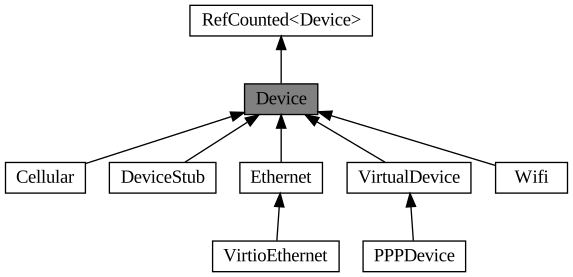
| * `Device` is the base class for a hierarchy of subclasses that perform |
| technology-specific behavior: |
| * [Cellular](cellular.md#Cellular) |
| * [Ethernet class](../ethernet/ethernet.h) |
| * [VirtualDevice class](../virtual_device.h) |
| * See also [vpn.md](vpn.md) |
| * [WiFi class](../wifi/wifi.h) |
| |
|  |
| |
| * `Device` instances are managed by [DeviceInfo](#DeviceInfo). |
| * Exception: `VirtualDevice` instances corresponding to virtual interfaces |
| (for use-cases like VPN, and cellular dongles). |
| |
| |
| ## ServiceProvider |
| |
| The [ProviderInterface class](../provider_interface.h) is a common interface for |
| singleton instances owned by [Manager](#Manager). |
| |
| * Each `ServiceProvider` is responsible for creating [Service](#Service) |
| instances on startup and as required by the associated [Device](#Device). |
| * A separate `ServiceProvider` singleton exists for each primary Technology: |
| * [CellularServiceProvider](cellular.md#CellularServiceProvider) |
| * [EthernetEapProvider class](../ethernet/ethernet_eap_provider.h) |
| * [EthernetProvider class](../ethernet/ethernet_provider.h) |
| * [VpnProvider class](../vpn/vpn_provider.h) |
| * [WiFiProvider class](../wifi/wifi_provider.h) |
| [][ProviderInheritance] |
| * `ServiceProvider` instances create new `Services` from the persisted state |
| in the [Profile](#Profile) and/or properties from the D-Bus interface. |
| * See [CellularServiceProvider](cellular.md#CellularServiceProvider) |
| for [CellularService](cellular.md#CellularService) provisioning. |
| * The `EthernetProvider` by default has a single `EthernetService`, which |
| the first `Ethernet` instance will use. Additional `Ethernet` instances |
| will cause the `EthernetProvider` to create additional `EthernetService` |
| instances. |
| * For `WiFiProvider`, `Services` are also created based on network scans |
| performed by `wpa_supplicant`, which leads to the reception of BSSAdded |
| D-Bus signals that trigger `WiFiProvider` to create a corresponding |
| `WiFiService`. |
| |
| ## Service |
| |
| The [Service class](../service.h) is a `base::RefCounted` class representing a |
| network configuration and a connection through an associated |
| [Device](#Device). |
| |
| * `Service` is associated with the [org.chromium.flimflam.Service] DBus API |
| documented in [service-api.txt](service-api.txt). |
| * A network interface on its own does not provide network connectivity, the |
| interface must be configured and the link layer connection must be |
| established by the relevant technology specific software (`WPA` for `WiFi` |
| interfaces, `ModemManager` for `Cellular`, `kernel` for `Ethernet`). |
| * A `Service` provides configuration properties to the associated |
| [Device](#Device) and helps setup the [Connection](#Connection) and drive |
| the connection state machine. |
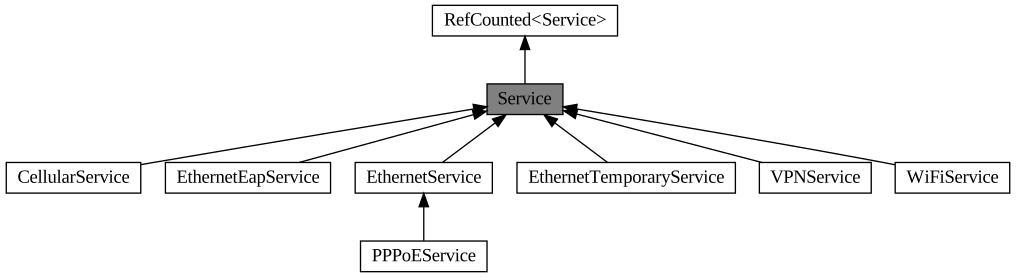
| * `Service` is the base class for a hierarchy of subclasses that perform |
| technology-specific behavior: |
| * [CellularService](cellular.md#CellularService) |
| * [EthernetService class](../ethernet/ethernet_service.h) |
| * [EthernetEapService class](../ethernet/ethernet_eap_service.h) |
| * [VPNService class](../vpn/vpn_service.h) |
| * See also [vpn.md](vpn.md) |
| * [WiFiService class](../wifi/wifi_service.h) |
| |
|  |
| |
| * A `Service` has an associated `Device` instance, stored as a type specific |
| `RefPtr` in the subclass. |
| * `Service` lifetime is managed by the associated |
| [ServiceProvider](#ServiceProvider) singleton. |
| |
| |
| ## Profile |
| |
| The [Profile class](../profile.h) represents a set of persisted data and is |
| used for both `Device` and `Service` properties, as well as a handful of global |
| properties. Shill keeps a `Profile` instance for shared/default properties, |
| and a per-user Profile when a user is logged in. |
| |
| * [Device](#Device) and [Service](#Service) classes and their subclasses |
| handle loading from and saving to the underlying storage used by the current |
| `Profile`. |
| * Shill allows for a stack of `Profile` instances. The `Profile` stack is |
| owned by [Manager](#Manager). |
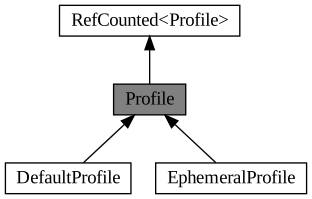
| * On startup, the `Profile` stack contains a single `DefaultProfile`, |
| which provides pre-login (shared) configuration data. |
| * In addition to the regular `Profile` behavior of persisting |
| `Service` properties, a `DefaultProfile` will also persist `Device` |
| properties and a subset of `Manager` properties. |
| * On user login, specifically when Chrome instructs session_manager to |
| emit the load-shill-profile upstart event, the |
| [`shill_login_user`](../bin/shill_login_user) script is run. |
| * This creates a `Profile` for the user and pushes that `Profile` |
| onto the `Profile` stack. |
| * On user logout, [`shill_logout_user`](../bin/shill_logout_user) removes |
| the user's `Profile` from the `Profile` stack. |
| * When a guest user logs in, a `Profile` is created and pushed onto the |
| stack as usual, but the persisted data is deleted on logout. |
| * An `EphemeralProfile` (see below), is *not* used for guest users. |
| This allows persistence of properties after a shill crash within |
| a guest user session. |
| * Every `Service` has exactly one `Profile` associated with it, which is |
| the`Profile` most recently pushed onto the `Profile` stack. The `Profile` |
| contains persisted data for the `Service`. |
| * An `EphemeralProfile` is used exclusively for `Service` instances that are |
| created but that have no `Profile` in the `Profile` stack, e.g., a |
| `WiFiService` that was created from a WiFi scan but that the user has never |
| attempted to configure or connect to. |
| |
| {inl} |
| |
| * A `Service` can be "linked" to a different `Profile` through the use of the |
| `Service` kProfileProperty D-Bus property, which is how `Service` instances |
| currently using the `EphemeralProfile` can be moved over to a `Profile` that |
| allows its configuration parameters to be persisted. |
| * *Note* Shill's D-Bus clients (aside from Autotest/Tast) do not create |
| additional `Profiles`, so the `Profile` stack in non-test cases contains |
| only the `DefaultProfile` and potentially a user `Profile`. The |
| `EphemeralProfile` is not part of the `Profile` stack. |
| |
| |
| ## IP Configuration |
| |
| *TODO:* Document the [IPConfig class](../ipconfig.h) and IP configuration. |
| |
| |
| ## Connection |
| |
| * The [Connection class](../connection.h) is owned by the |
| [Device](#Device) that sets it up and is shared by the active |
| [Service](#Service) for the `Device`. |
| * [Manager](#Manager) uses the `Connection` of the default [Service](#Service) to |
| configure /etc/resolv.conf (DNS). |
| * *TODO:* Properly document the [Connection class](../connection.h). |
| |
| |
| ## AutoConnect |
| |
| *TODO* |
| |
| |
| ## Power Management |
| |
| *TODO* |
| |
| |
| ## DBus |
| |
| * DBus permissions are configured in |
| [org.chromium.flimflam.conf](../shims/org.chromium.flimflam.conf) |
| * Shill implements the following DBus APIs: |
| * [org.chromium.flimflam.Device] |
| * [org.chromium.flimflam.Manager] |
| * [org.chromium.flimflam.Service] |
| * [org.chromium.flimflam.IPConfig] |
| * [org.chromium.flimflam.Profile] |
| * [org.chromium.flimflam.ThirdPartyVpn] |
| |
| |
| # Glossary |
| |
| [ProviderInheritance]: https://docs.google.com/drawings/d/13bSfym4MoC3qxQS1c7aiJktyJkzs8qmF6-ulh57mbuE |
| [org.chromium.flimflam.Device]: ../dbus_bindings/org.chromium.flimflam.Device.dbus-xml |
| [org.chromium.flimflam.Manager]: ../dbus_bindings/org.chromium.flimflam.Manager.dbus-xml |
| [org.chromium.flimflam.Service]: ../dbus_bindings/org.chromium.flimflam.Service.dbus-xml |
| [org.chromium.flimflam.IPConfig]: ../dbus_bindings/org.chromium.flimflam.IPConfig.dbus-xml |
| [org.chromium.flimflam.Profile]: ../dbus_bindings/org.chromium.flimflam.Profile.dbus-xml |
| [org.chromium.flimflam.ThirdPartyVpn]: ../dbus_bindings/org.chromium.flimflam.ThirdPartyVpn.dbus-xml |
